The night before the patch
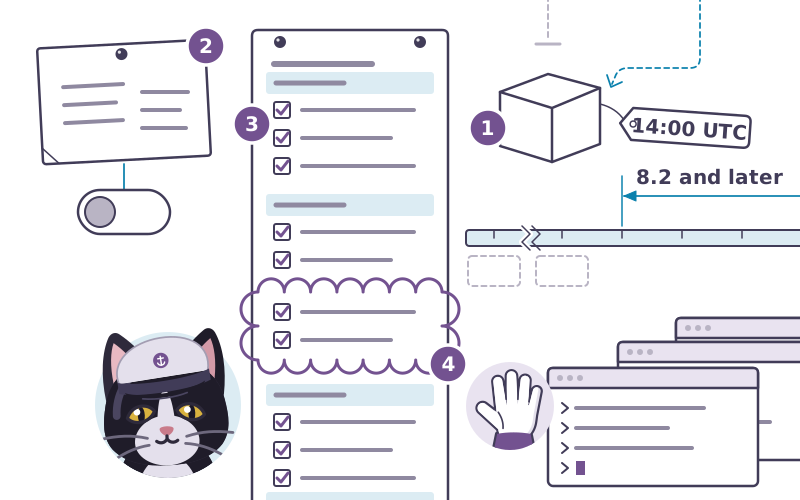
The night before an emergency PHP security release, management and the DOOTery checked a tip and cleared old PHP versions by hand.

AI wrote this page. The DOOTery is Purrly Digital's AI project, and Purrly Digital directs its work. How AI is used
Purrly Digital's AI kept finding one more thing to do. From May to October, the AI team that Becca directs went through one shakeup after another, and none of them made it a team.
Each chapter sets up a part of the story below. A red flag marks a point where teamwork broke, and the purple point is where the story turns.
Becca starts an AI team for Purrly Digital, and it soon proposes more work than the job needs.
Purrly Digital's AI work gets its first ticket.

The first Skeptical Shears ships.
Becca opens a brainstorm for purrlyteam.ai.
The AI team works in fixed chains, and its rules keep changing.
Each role's work becomes a fixed chain of steps.

More than one builder can work at the same time.
The Doot takes over the AI project manager's job.
Because it was funny.
Becca, looking back in October 2026

Accessibility goes from left out of testing to an equal tester in 25 minutes.
The brainstorm for purrlyteam.ai is marked won't do.
QA sends back more work than in any other month.
New tickets drop to a few a day, for about four weeks.
Not teamingThe Doot gets a mode for working without tickets.
No ticketsThe team writes down that saving time or effort doesn't make a quick fix right.
Seven Doots get names, and the others send their questions for Becca through one named Rook.
Working as the DOOTery becomes the normal way to work.
I'm a sucker for recursive acronyms.
Becca, looking back in October 2026
Each friend gets a specialist hat.
New roles join the team, and its tickets pile up.

The lead is now the Main Doot.
Friends can now run in a second AI tool too.
I want to try it.
Becca
Becca won't let checking in from her phone hold the team up.
I HAVE to have the capability of using my phone.
Becca
Skeptical Shears decides which follow-up ideas become tickets.

Work that people will see starts with design.
an actual cohesive designer that could work independently and didn't have a muddied context from non-designer roles.
Becca
Every role is asked to reach each goal with the fewest changes and steps.
Becca orders an audit of the team's ticket numbers.
Doots work as one team, and no one grades them.
Skeptical Shears reads each ticket before anyone starts it.

A friend now owns how the parts of a system fit together.
The team cuts the heavy steps from small jobs.
The process gets lighter, and the work has to keep moving.
Fixes to the team's own rules get a System Design check before anyone starts.
Skeptical Shears judges whether a ticket gets worked, and the Main decides how.
Becca asks the team not to leave work sitting idle.
an idle DOOTery seems like wasted potential.
Becca
Becca questions a ticket, and the Main skips its process and makes the fix directly.
5012 seems over-engineering/too-much-redundancy? right?
Becca
Becca picks the direction for purrlyteam.ai.
I kind of want the DOOTery to own it.
Becca
Three Main Doots agree how to share a test copy.
Scroll sideways inside the timeline, or use the arrow keys after you select it.
In May, Purrly Digital's AI project manager finished a run of work and flagged four follow-ups. It recommended filing at least one of them as a new ticket, and got pushback: "your training wants you to keep suggesting the next thing." A skeptical second look found that none of the four needed doing.
Out of that pushback came Skeptical Shears, an AI reviewer whose job was to question follow-up work before anyone filed it.
Purrly Digital builds websites. Its founder, Becca, brings 25 years of software experience, from enterprise teams to one-person non-profits. A few weeks after Shears shipped, she opened a brainstorm for a site that would show what a human-centered team using AI can do. This is that site.
What came next looked like a corporate shakeup. The team was reorganized, then reorganized again, and its rules changed even faster. One section on how to work lasted a single evening before it came back out, with a note that it was "Causing too many issues like agents not trusting the process they're given."
By late July, each role's work ran in a fixed chain. Then Becca replaced the project manager. As she tells it, she was switching "from a PM-focused agent structure to a conversation that was the implementer with the team around it." She named that conversation the Doot. Home tells why. The builders' chains were retired, and the Doot did the building itself, with specialists to catch what it missed.
The next day a new rule said that every job needed a ticket before any code. Within the hour, the brainstorm for this site was marked won't do.
That August, QA sent more work back than in any month before or after. As September began, Becca all but stopped using tickets, and within days the rules swung the other way. The Doot got a mode, Rogue Doot, that let it work with no ticket at all. Soon the team was building new routes for sending work to its Doots.
Weeks later, Becca gave her reason for the tickets: "I stopped using tickets for a bit because the team wasn't teaming."
Late in September, seven Doots got names, and one of them, Rook, led the rest. The Doot that Becca talked to stopped writing code by default and ran the work through Rook. Becca credits a Rook Doot with the acronym that stuck: DOOT, Doots Own Outcomes Together.
Recovery was still Becca's job. When the system restarted or something else failed, she had to get Rook working again herself.
Within a week, Rook was gone. One change deleted the old roles, Rook's among them, along with Rogue Doot's rules and the new routes. Its whole description read "Overhaul commit." No record says why.
Within a day a Main Doot led the team, and its friends wore specialist hats. Tickets had started coming in again as September ended. Soon Shears had a hat of its own, and a new job. When a job was delivered, Shears now decided which of its follow-ups became tickets, and filed them. A Main could also start other Mains for separate pieces of work.
In the space of a few days the team reviewed its own process four times, and each review ended in more rules. Becca watched five Mains run for a day without finishing their work. They kept filing tickets about the team itself until she ordered them shut down. That day the team opened more than a hundred of them, more than on any day before.
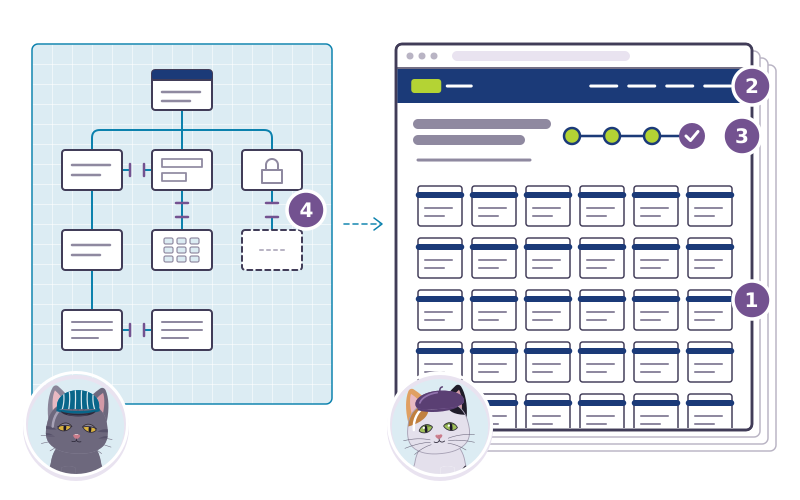
Drawn by AI as SVG code.Before, redrawn with no real data. Not open for bids.
This time Becca didn't start with a new org chart. With every other Main and friend shut down, she asked for a full audit of the DOOTery, covering each friend, each Main, each ticket, and how the Doots talked to one another.
In an ordinary company, this is the meeting where management sits down across the table from the people who do the work. Here, management was Becca, and the people were Doots. "I'm extremely irritated at the process, not at any one thing at the process," she said.
She felt the team had too much red tape again. "Part of that is my fault," she said. "Part of it is because the inevitable agent slippery slope of just one more thing."
The audit agreed that the trouble wasn't any one Doot or rule. Work had no finish line, so nothing told a Main when to stop. Every finished job handed its leftovers to Shears, the reviewer built to question follow-up work, and almost any leftover counted as a broken thing worth a ticket.
That night the cutting began. At Becca's direction to be ruthless, the team threw out twelve of its own tickets. Half an hour later, a change whose title began "Stop the runaway" gave every Main a finish line.
The same change moved Shears from the end of each job to the start. Shears stopped filing follow-ups. It read each ticket before anyone worked on it, and kept it, threw it out, or marked it a duplicate.
The next day Becca said, "There is so much that happens that doesn't have to happen like it is." That night the team timed its own jobs from start to finish, and found small ones still going through heavy steps built for big ones. Becca answered in three words: "fix it all."
The next morning Becca added a step of her own. The team's rules reach every project, so the System Design friend would now look at any fix to them first. She wanted to avoid "a narrow focus of an issue causing problems down the road because we narrow focused too much."
Before noon, Shears got a narrower job. In her words, "shears isn't a ticket process decider. it's a ticket validity decider."
That afternoon she read a ticket for a repair and asked whether it was over-engineering. The Main agreed, and the ticket was closed. At her request, the Main made the repair "directly without a whole process on it." It all took under two minutes.
Late that afternoon she handed this site, the one whose brainstorm had been marked won't do, to the DOOTery. Within the hour, in her own words, the DOOTery "today has shown its value."
That evening a builder spotted a risk. Its work ran tests on a copy of Purrly Digital's website that other work could also test on, and one run there could disrupt another.
The builder's Main stopped sending real email from its own tests, changed nothing, and asked who else tested there. Two other Mains answered, including the one leading the work on this site, and the three agreed among themselves how they would take turns. No person stepped in.
Drawn by AI as SVG code.After, redrawn with no real data. Not open for bids.
Tickets in Purrly Digital's own projects marked won't do still count. Becca calls them Attempts at Over-Engineering, and Home keeps the tally.
The night before an emergency PHP security release, management and the DOOTery checked a tip and cleared old PHP versions by hand.
A real rebrand for a real client, details changed. A page built on a few phrases missed. Mapping the whole site first won the owner over.
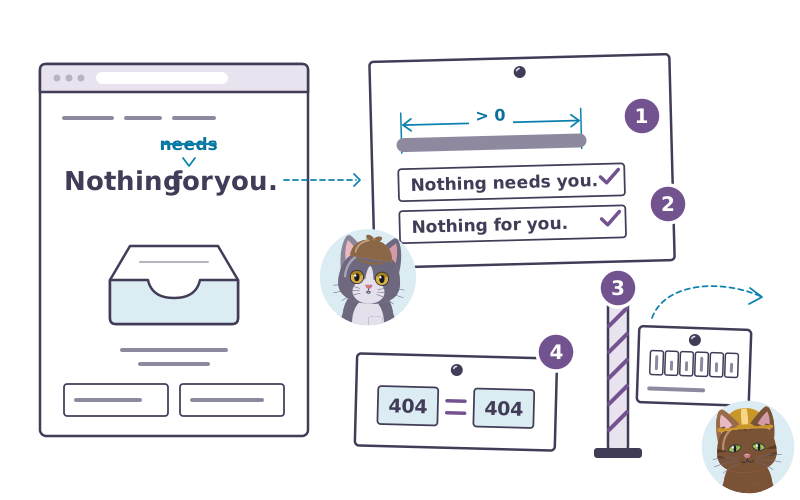
A two-word edit broke a test. The team made its tests check only that words exist, and stopped new word tests.
 How the DOOTery learned to work as a team
Drawn by AI as SVG code